01 · C++
Install C++ and run your first program
Distinguish source text, the compiler and the executable, then run your first C++ program.
C++ · Application
Design warehouse routes and solve logistics puzzles with automated transport vehicles.
In developmentThe GitHub link follows after repository publication. The source ZIP contains the verified local snapshot. The Linux app was tested. Native Windows verification and public binary downloads are still pending.
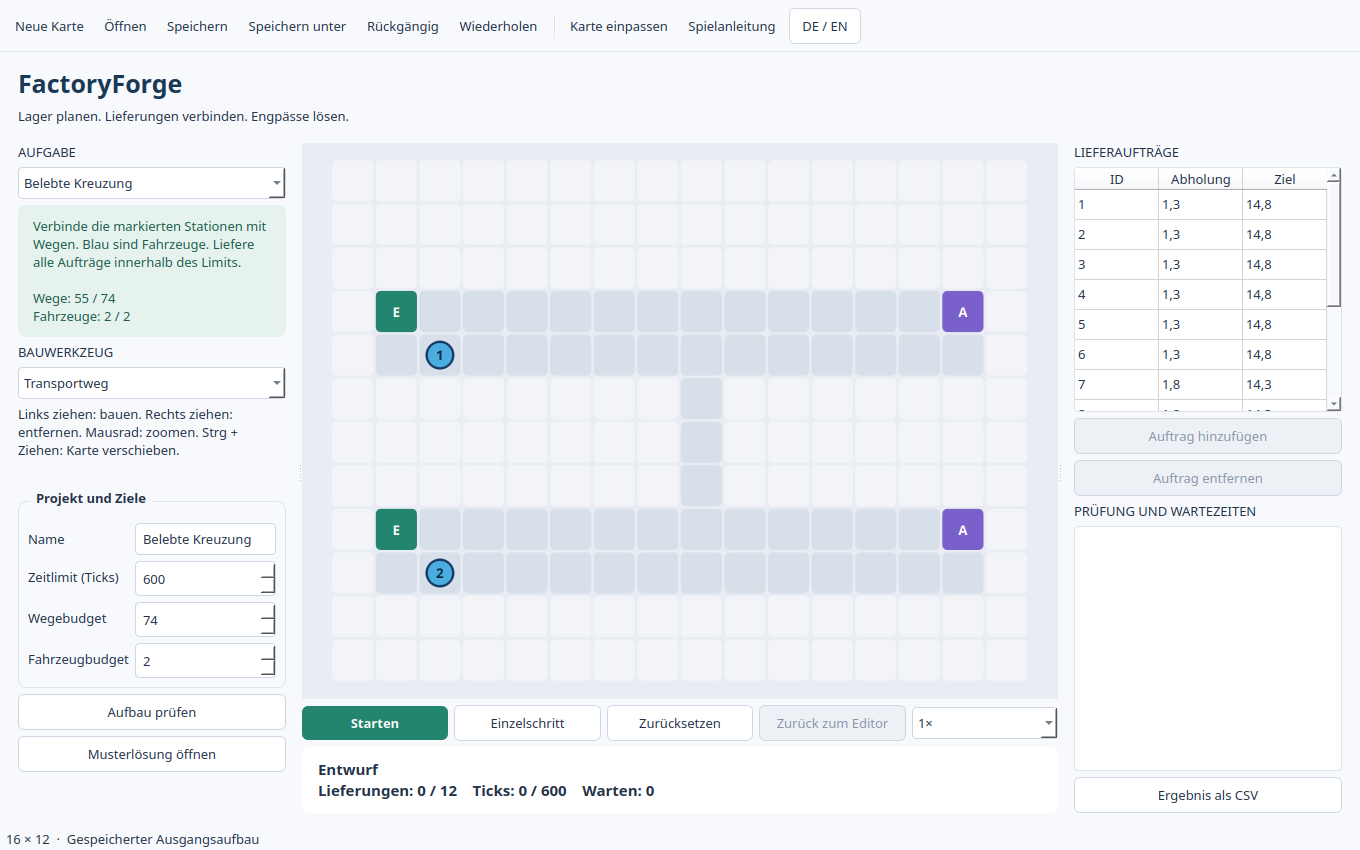
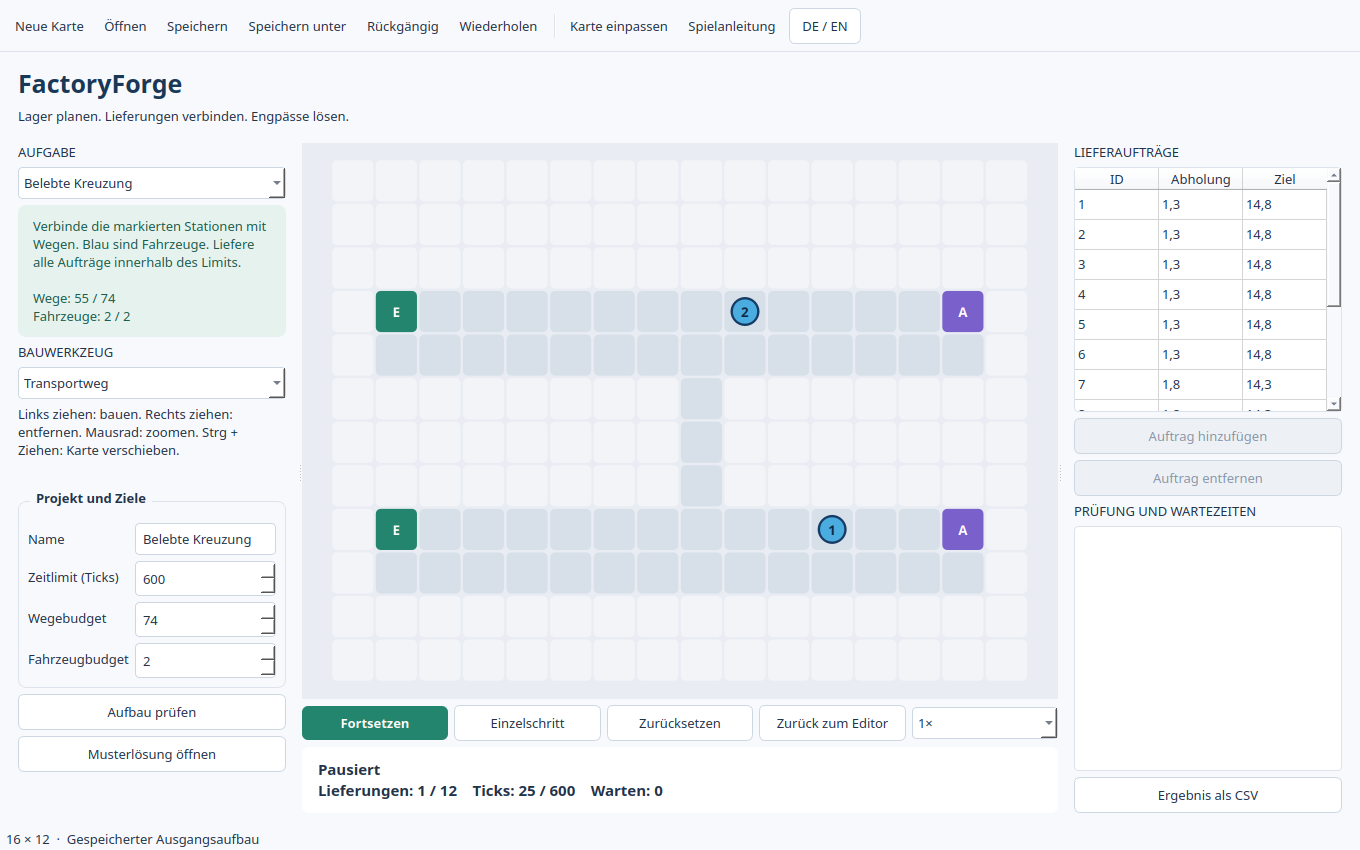
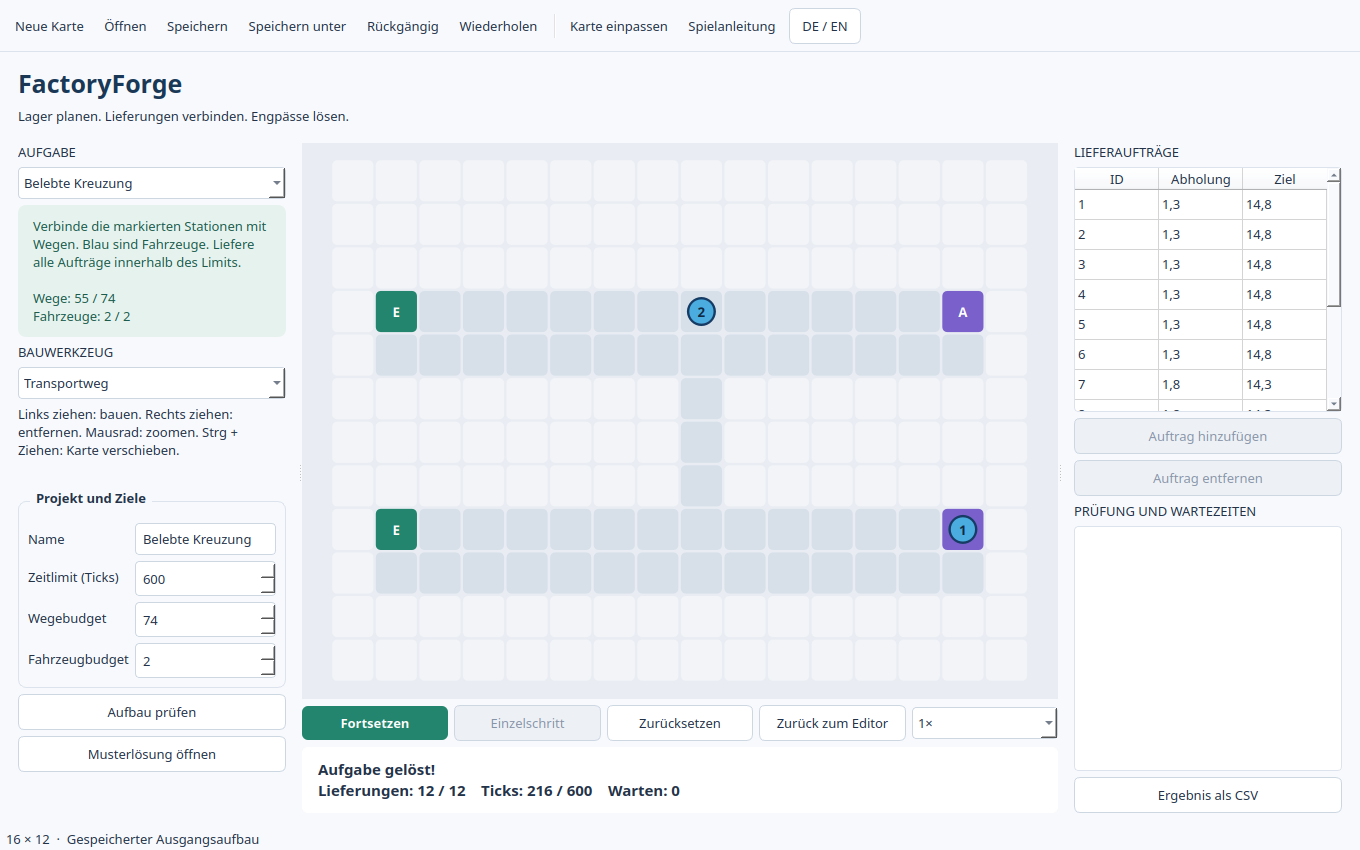
Fixed ticks separate game rules from rendering. Time-based cell and edge reservations prevent collisions. The bounded planner reports blocked vehicles and does not guarantee globally optimal fleet routing.
Ten core tests, five application tests, Qt file/interface tests and five real puzzle-file runs passed. AddressSanitizer and UndefinedBehaviorSanitizer passed the four original test suites. All nine teaching examples compiled and ran. The documented 50-vehicle scenario delivered all 150 orders. Native Windows verification is still pending.
Licence: Apache-2.0 · Qt LGPL-3.0 · Source checked on 13.10.2026
FactoryForge is a C++20/Qt logistics game with a map editor and deterministic transport simulation. The linked source revision documents the actual app. Tutorials 16 through 24 add independent teaching programs in the same technology area. The Order Lab capstone is an order manager, not a new version of the game.
The game separates pathfinding and simulation rules from the Qt editor. Order Lab demonstrates this dependency direction for another task: widgets call an application service using a replaceable repository interface. An in-memory implementation enables isolated tests. The SQLite implementation is additionally tested with real files and transactions.
An import first creates a preview. Only explicit confirmation replaces saved orders. Invalid files and SQL failures during the second insertion preserve existing data. If changes were saved after the preview, the app requires a fresh preview. Network examples check cancellation, deadlines and outdated replies.
Tutorial 24 provides a complete ZIP containing a CMake project, German and English guides, an exercise solution and a verification entry point. The widget test creates an order, reopens the database and edits it. Additional workflows cover file import, a real local HTTP import and database rollback. The same flow can be demonstrated in the English-labelled interface and explained through the code during an interview.
Evidence covers the published teaching code on Linux with Qt 6.8.3. SQLite and network import belong to Order Lab and are not claimed FactoryForge app features. Its file format is separate from the game project format. Concurrent writing processes, power-loss durability and native Windows interaction have not been accepted. Source and tests enable technical review but do not replace personally explaining the decisions.
01 · C++
Distinguish source text, the compiler and the executable, then run your first C++ program.
02 · C++
Calculate transport trips and divide the problem into reusable instructions.
03 · C++
Store several order IDs in a container and sort them using the standard library.
04 · C++
Group vehicle data into a type and observe automatic resource cleanup when a scope ends.
05 · C++
Build a multi-file project and verify business boundaries with GoogleTest.
06 · C++
Build a window, react to a button and draw a road element.
07 · C++
Trace an editor draft through changes, undo/redo and a verified file round-trip.
08 · C++
Understand grid-based path search and run the same simulation without its graphical interface.
09 · C++
Observe a stoppable simulation service and verify measurable, distributable software.
10 · C++
Transfer exclusive ownership and verify when a resource is released.
11 · C++
Reproduce a heap access outside its bounds and verify the repaired version.
12 · C++
Compare unprotected shared writes with a synchronized implementation.
13 · C++
Constrain a generic algorithm and verify accepted types at compile time.
14 · C++
Keep the previous file contents intact when a preparatory write fails.
15 · C++
Build and test separate configurations and verify an installable package.
16 · C++
Process orders without unnecessary input copies and explain when a borrowed view becomes invalid.
17 · C++
Separate expected validation failures from exceptions and preserve the previous state when a batch update fails.
18 · C++
Develop an application service independently of its storage and test read and write failures separately.
19 · C++
Separate order data from presentation while preserving record identity during sorting and editing.
20 · C++
Load orders without blocking the UI and handle errors, cancellation, size limits and outdated responses.
21 · C++
Implement a persistent repository and demonstrate that a mid-import failure leaves no partial changes.
22 · C++
Load older files, add defined defaults and reject unknown formats without changing existing data.
23 · C++
Verify inputs, table and application service working together through reproducible widget tests.
24 · C++
Combine a UI, application core, SQLite, file import and network import into an executable engineering work sample.